Slivers of paper, pencil sharpenings, crisp packets,
Neighbours blame the inconsiderate young people but let’s look a little closer….
Yes it’s adults with babies dumping their diapers (nappies)
A bag full goes in our bin to be collected by the city corporation (MCC).
Why can’t the people give their rubbish to the MCC who collect most mornings?
The fading Firangi (foreign pensioner) chooses to clear it up. My neighbours blame the students and it’s partially true but on closer inspection — it’s the babies shit now smeared all around by the dogs — who’ve adopted the park that’s made it worse.
So all ages are responsible together with their team mates, the dogs…. It’s not just due to the corporation not clearing up. People need to learn to put things in a bin and not expect other to clear up after them.
We had similar problems in the U.K. in the past.
The keep Britain tidy logo
So there was a countrywide campaign, decades ago to stop people littering.
Were organised by Manjula’s Mysore at Kaliyuvamane, the ‘open’ school that Kaveri attends in Mysore and separately for an NGO working with visually impaired young women.
Why?
… because it’s an ‘alternative’ approach we think reflects our way of thinking and that of the school.
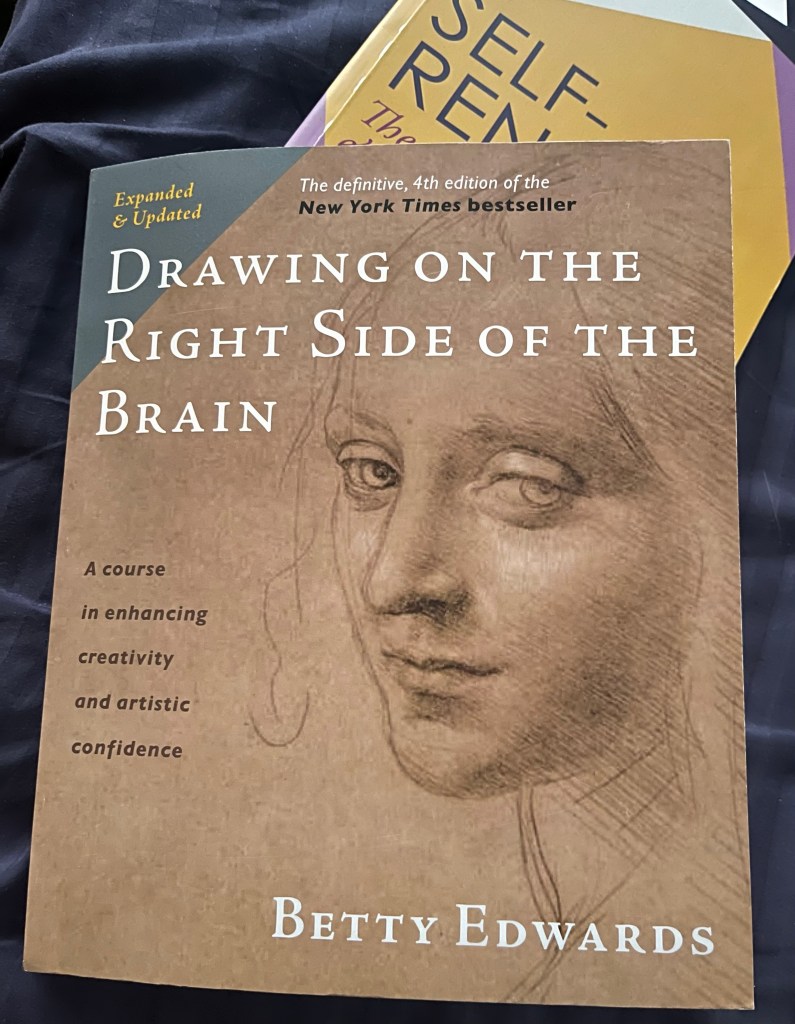
Betty Edward’s writer of ‘Drawing on the Right Side of the Brain’ puts it well…
“throughout many cultures … there is much talk of creativity and our need for innovation and invention. “ …. Yet …
“our education system seems bent on eliminating every last bit of creative perceptual training of the right side of the brain, while overemphasising the skills best accomplished by the left side of the brain: memorising dates, data, theorems, and events with the goal of passing standardised tests.”
Edwards believes that “with careful teaching transfer, drawing and reading together can educate both halves of the brain.”
Indeed the management guru Tom Peters declared innovation as the no 1 competency for successful, thriving organisations. That was also reflected in the work of John W Gardner author of ‘excellence’ and ‘self-renewal: the individual and the innovative society’
As I look into this more, I realise that creativity helps us develop and use the right side of the brain to enhance our perception and to bring meaning into our increasingly complex worlds.
It’s therefore no accident that we’ve promoted “two vital global skills: reading and drawing.”
I hope MAnjula was happy and proud that in her memory we’ve tried to better equip young people for the challenges they’ll face, bringer greater equilibrium and help them find their passion.
Yesterday evening as I was waiting outside a shop selling dots for one’s forehead —
—Manjula used to give them as gifts as we travelled through England—
A woman asked where she was.
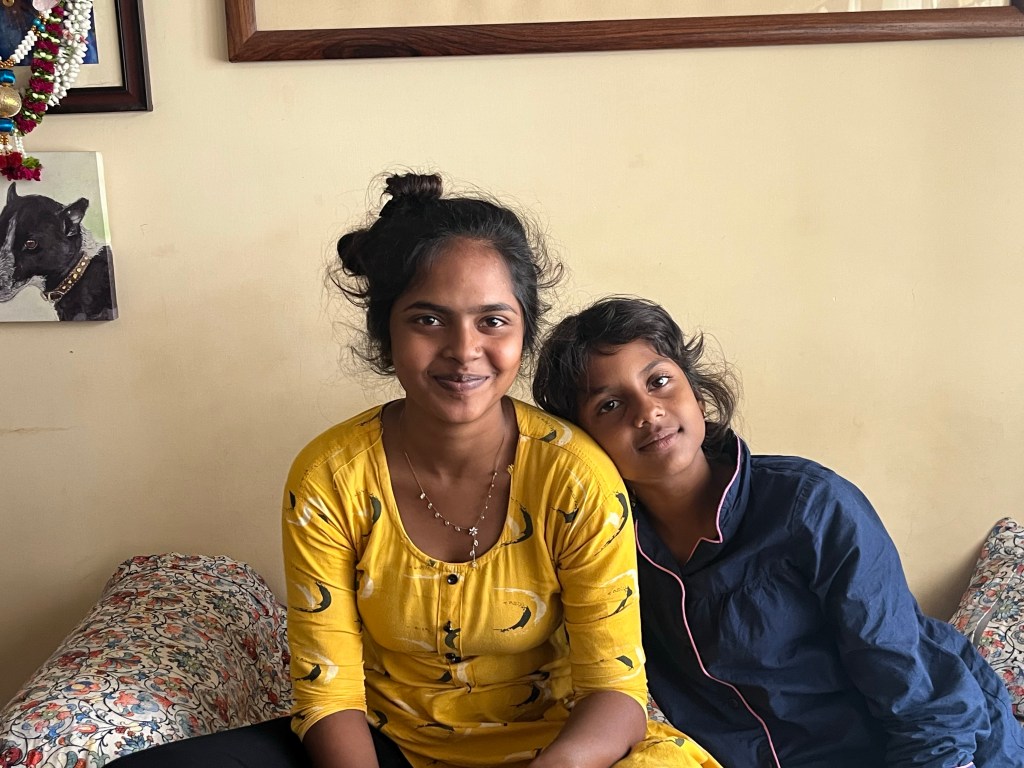
I pointed to, inside the shop and after a perplexed reaction, realised she wasn’t asking about the little girl (Kaveri) or Manjula, for that matter, but the dog (Lucie).
The girl was stocking up for the return to school.
I’m well known in my area and in Mysore generally but usually because of my appendage.
I am nothing, not even a number.
…
I once walked into a hotel (restaurant) right on the other side of the city, for the waiter to ask me where’s the dog. He also lived in Siddarthanagar.
So I’m well known for who I’m with …
As of this morning, as I realise, I stick out like a sore thumb as generally there’s rarely other firangis (foreigners) here. There’s a new appendage.
A tree
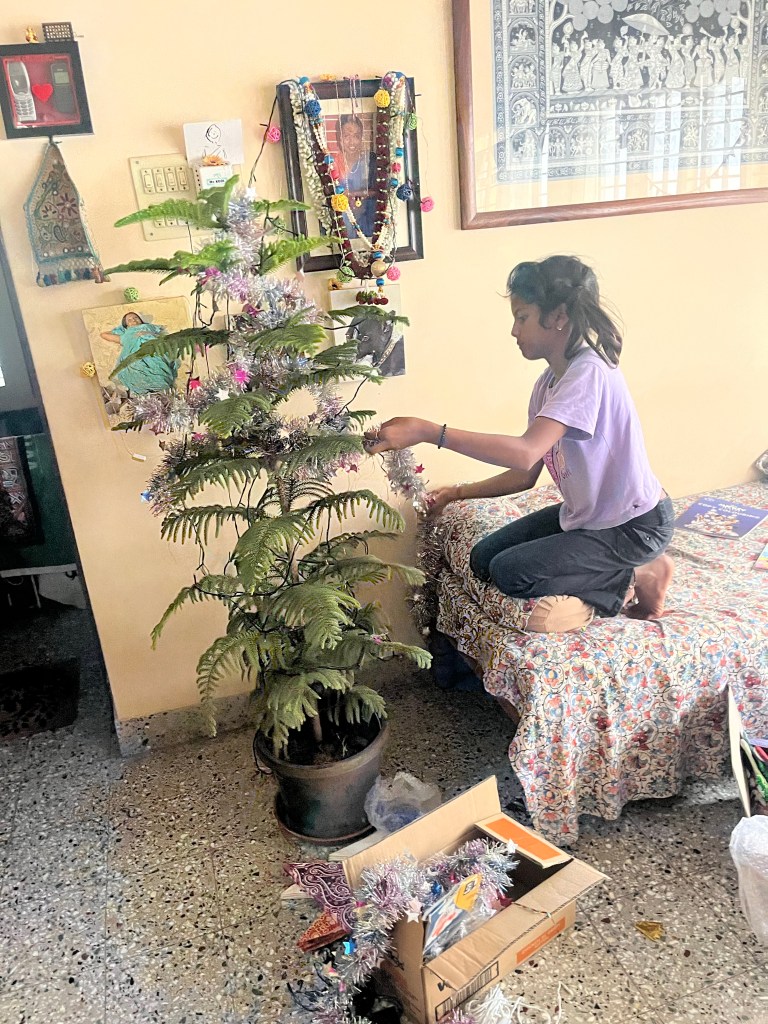
As I was tossing and turning in the midst of my AWOL, nightly sleep I realised there was only this morning for me to be able to decorate the tree for Christmas.
Kaveri will be going back to school.
Kaveri is here for less than 24 hours and we’ve decorated it together for the past three years since we met. I’ll not see her again until a few days after Christmas Day when we’ll belatedly celebrate Christmas.
A bit too late to do the tree
Plus our usual totem is now too big and heavy for the hall aka lounge.
What to do?
Easy
Get up before the girls and after walking as man and dog, I go out again, to the nearest ‘nursery’. It’s run by guys from UP on the roadside. I haggle with them from the Firangi-Gora (white) — tax – price, to something resembling the price a local would pay. About half.
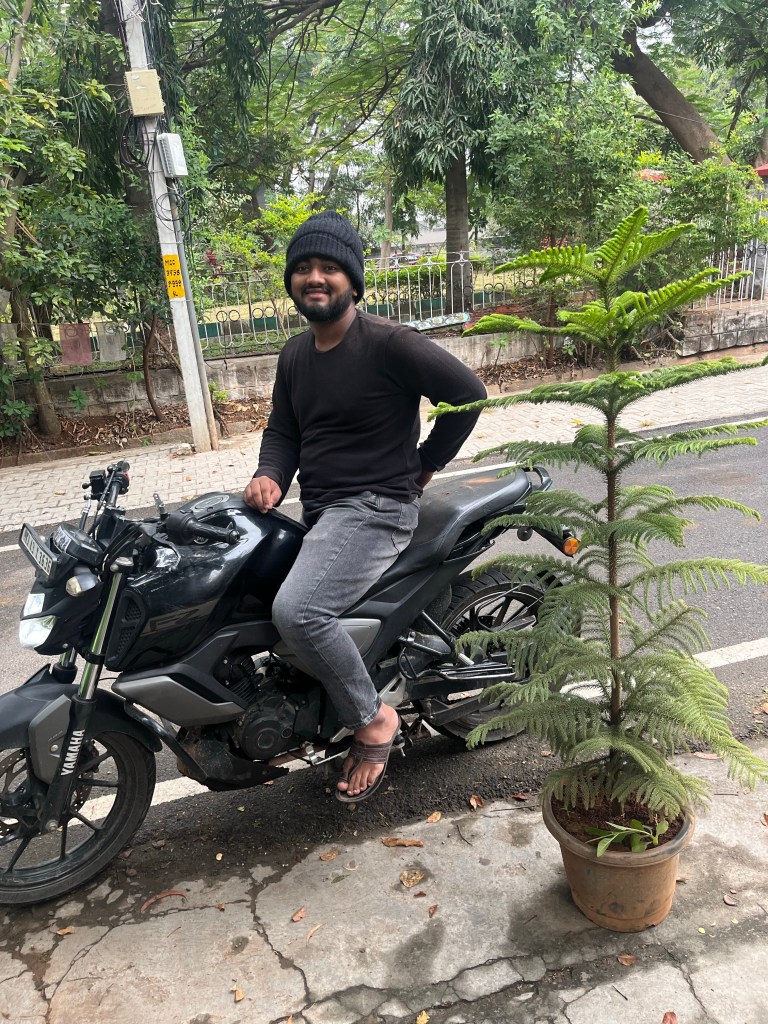
Then as I’m trudging home— convincing myself that I’m exercising my muscle diminishing 60+ years arms —- with very regular rests. I realised I’m another spectacle of the foreigner ‘variety’ who is entertaining the locals, especially the men at the chai shop and the women sweeping the streets. They’re interested as no one can possibly work out why the rich foreigner is carrying a tree and not using an auto rickshaw.
A wonderful young man, rescues me from the ordeal of the last stretch, stops for me to balance precariously on the back of his bike and gets me home.
I’ve become the foreigner, not only with dog and girl but now the tree
It suits me
…
Ok it doesn’t look very heavy but the weight is in the pot.
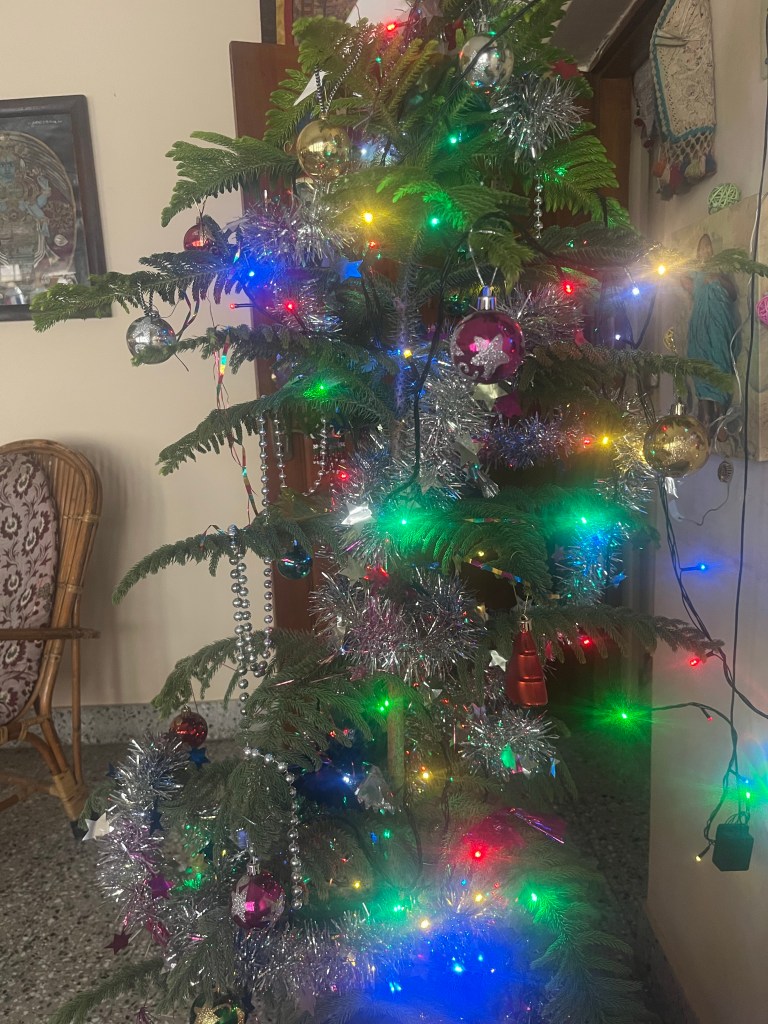
It’s now decorated.
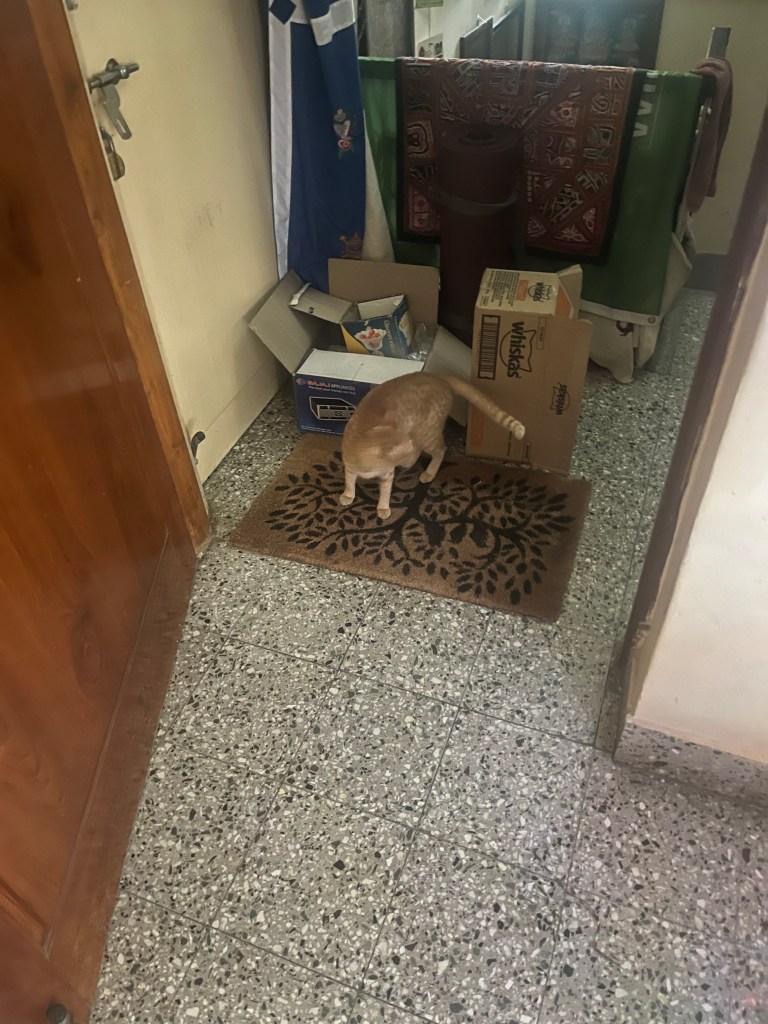
But now the cats eyeing it up, for a potential attack thankfully for the moment she seems satisfied with the empty decoration boxes.
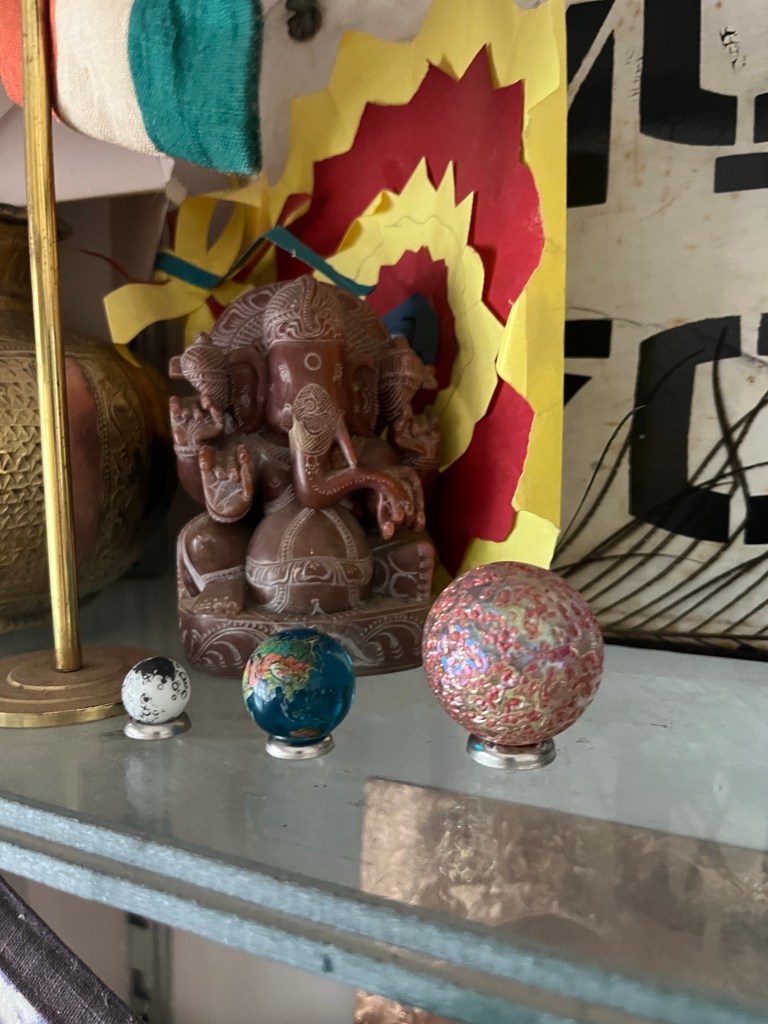
Ganesh, originally bought from the stone carvers in Tamil Nadu with representations of — (from the left) the moon, earth and sun.
I’ve adapted one of his key stories to share with Kaveri and Radhika.
It traditionally goes like this …
Ganesh and his brother have a race round the world to prove who’s fastest.
If we were asked to predict who would win we’d think his brother, as Ganesh aka Ganpati isn’t lithe and doesn’t look fit. Plus .. He eats a lot!
His brother is shocked to find Ganesh already there when he breathlessly reaches the finishing line.
It turns out Ganesh raced around his world (his parents) and his brother raced around the whole world (planet earth).
My addition.
There’s no right or wrong here, both raced around important worlds. Fact is — we occupy many worlds— at school, where we live, amongst our friends, work. It’s important for us to realise these different worlds — an understanding of which — helps us realise how people see things differently.
Only then … can we — Be Kind— (a regular message to Kaveri), as that depends on us understanding how each person sees things. No point ‘being kind’ in ways that ‘the other’ person doesn’t value or recognise.
Manjula’s Library
Factoid !?
Kartikeya ), also known as Skanda, Subrahmanya, Shanmukha and Murugan, is the Hindu god of war. He is generally described as the son of the deities Shiva and Parvati and the brother of Ganesha.
Lifted off the t’internet
All images are in Mysore Bed and Breakfast but non of his brother as he’s still racing around the world.
Help girls (and boys) prepare for adult life by introducing yourself and sharing your insights.
Manjula’s Mysore is inviting its guests and members of its monthly meeting: ‘reflective space’ to create a short Introductory video — talking to camera — to reveal what’s possible.
I often use the story of Ganesh and his brother racing each other to reveal to young people that we live in many different worlds — with our immediate family, at home, with friends, at work, our extended family, while travelling.
It’s important to recognise and value difference reflected in those different worlds. That helps us to realise what wide variety of opportunities exist for us.
Many young people don’t understand how different their lives could be.
If we know more, we’re more enlightened and can better choose the life we wish to have, and find what suits us best.
Breaking the crate.
It might mean challenging the status quo and breaking away from what’s traditionally expected of us.
Sharing examples gives others strength.
This idea came from how much Kaveri learned about other people’s worlds by meeting guests of all ages — from India and around the world—- at Mysore Bed and Breakfast.
I hope this helps broaden her horizons and seize opportunities
Manjula realised — that even with a limited education, from a poor background having experienced so many difficult challenges throughout her life — she could create a wonderful home, share it with people from around the world, become a company director, manage our business and teach a Firangi a thing or two!! (Many things actually)
I’ve tried to help people become active participants in the decisions affecting them throughout my life.
I’ve worked to develop and improve their organisations as facilitator and manager since the early 80s.
Initially this was in NGOs and government but later in my career i was guide: consultant and trainer working with MNCs (multi-national companies) and by developing partnerships.
Occasionally, here I’ll post opinion pieces and insights from my experiences. These are for anyone but particularly young people and especially members of our reflective space group here in Mysore.
With dancing elephants we introduced an award scheme. Years later we found an incredible coincidence.
Sometimes things were meant to be.
….
Manjula’s Library
There’s a great range of books including those on learning, management, history, philosophy and education in Manjula’s library at our house aka Mysore Bed and Breakfast. My favourites are the children’s picture books which are of course for all ages!
….
My MPhil was a research degree in Critical Management undertaken at Lancaster University in the 1990s
In my studies and practice, I focused on human behaviour in different contexts. When I reached my 60s, I realised I’ll never understand human behaviour 🤪
I’ve helped develop hundreds of projects over the years. As a facilitator no one probably associates them with me.
The choice is ours, whether it’s on an individual, organisational or societal level.
Some changes come easier then others but let’s stick with the question of — should we challenge and change?
In my view there’s an unequivocal yes.
As an individual and the networks, groups or communities we form, of course we change.
What’s learning if it’s not adopting and adapting to changing situations, and developing new ways of doing things (and thinking!).
Some people and organisations will challenge change and prefer to stick with the status quo.
When that happens, look a little deeper.
What’s their motivation not to want to change? Fear? Retaining or enhancing power?
One of the most important aspects of change is personal development, it helps create who we are.
But it’s also nonsensical to suggest there shouldn’t be change in our wider groups and society
It’s critical that we innovate and adapt, developing the requisite abilities. That might be number one priority.
Well not quite.
Our actual biggest challenge is friction, and by this I mean between people, their organisations, communities, and nations.
We need to develop effective sustainable relationships and to achieve that we need to learn to be kind.
That requires us to see things from the others’ point of view, to communicate, to connect, to be flexible and adapt.
Yes… change, constantly.
Maybe we can actually reduce violent conflict …. Now that would be cool.
So we can choose to change and not be stuck …
… in what previous generations have handed down to us
NOR
…. in our personal experiences and traumas
We can shift.
Simple eh?
Admittedly. It’s not straightforward … No it’s our life long challenge, to choose who we want to be and hopefully find happiness and contentment.
But if we’re not conscious and try we might just lose this lifelong opportunity.
There’s books I’d recommend, in Manjula’s library that help cover this.
So when we next hear someone rejecting change, said in so many ways: ‘that’s not our tradition’, ‘that’s how we do it here’, ‘it’s our culture’ we can’t, etc etc then it’s for the WPB
Ok, that might be a bit harsh, at least dive into more reflection and re-evaluation.
– Are our ways of thinking and doing fit for purpose anymore?
– Is it appropriate in this day and age?
Now that’s maybe opened a reactionary can-of-worms.
The following books are in Manjula’s library.
You might also want to check Vedanta! Perhaps recommend a book for the library.
I’m reminded to try and always leave meeting someone with warmth and care as it might be the last time we see them. I did with Ina but still need reminding to always be attentive, kind and share compassion.
Ina connected kindly with everyone she met, including Billet-DouxIna brought cuttings of Manjula’s fave plants Ina was a Buddhist.Sensitive to ageing Lucie, Ina bought her a special mattress Tanuja, Ina and SowbaghyaThat’ll do nicely, Lucie appreciates her comforting gift (having taken over the downstairs floor) and can pretend she’s the queen, when the cat’s not around. The two big buddies. Manjula and Ina who just might already be having a gas, a great time together, as souls who will reconnect.
Manjula and Lucie (our dog) Welcoming Ina to our home.
After that first visit she would field questions from our guests who came to share our home — Mysore Bed and Breakfast– were we a couple?
Ina acknowledged before us that we’d fallen in love.
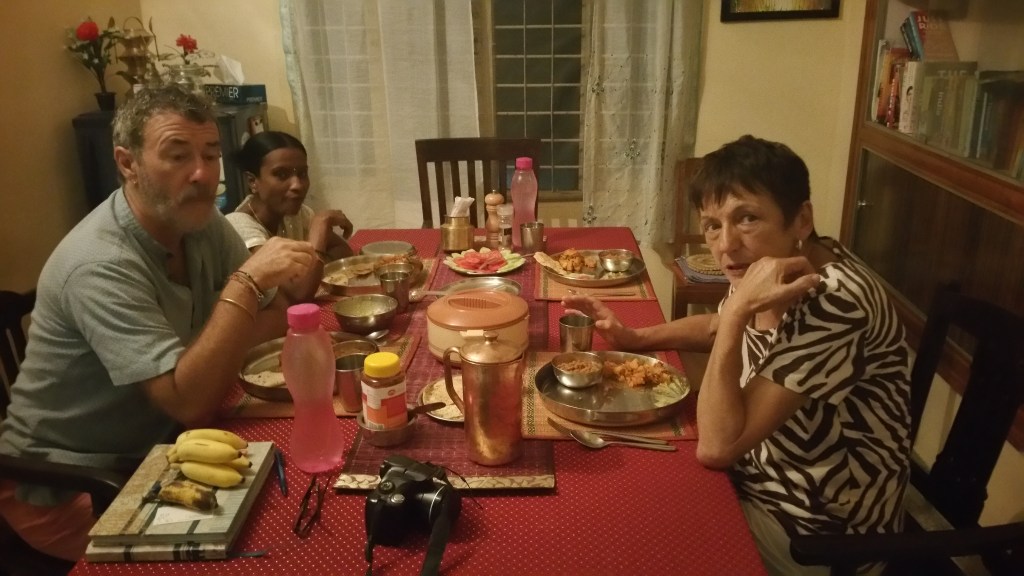
Ina came every year (except during the pandemic) from that first visit, for a total of ten years. She became a very close friend of my wife Manjula and a great support to me helping me grieve Manjula. She was our favourite and most regular guest, here Ina is promoting us with the new mug and proving she became an essential part of the team (furniture!).
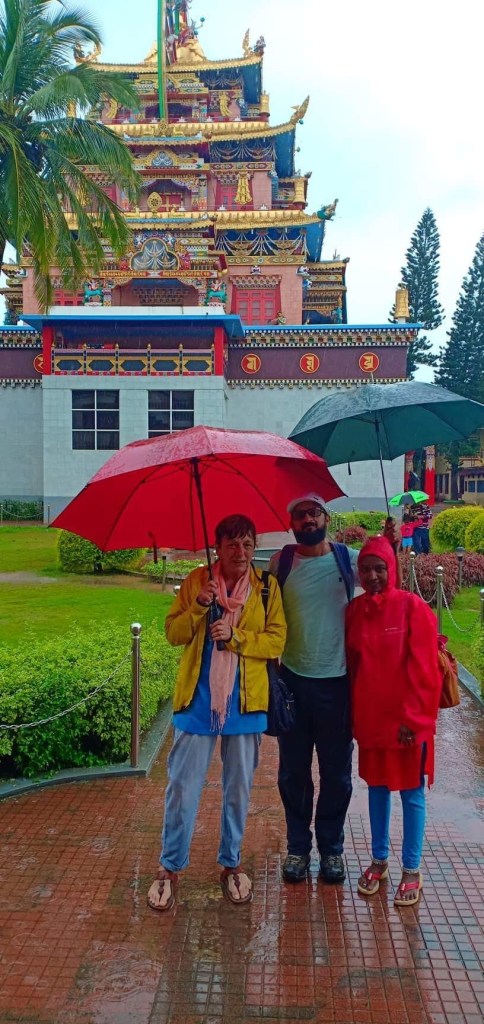
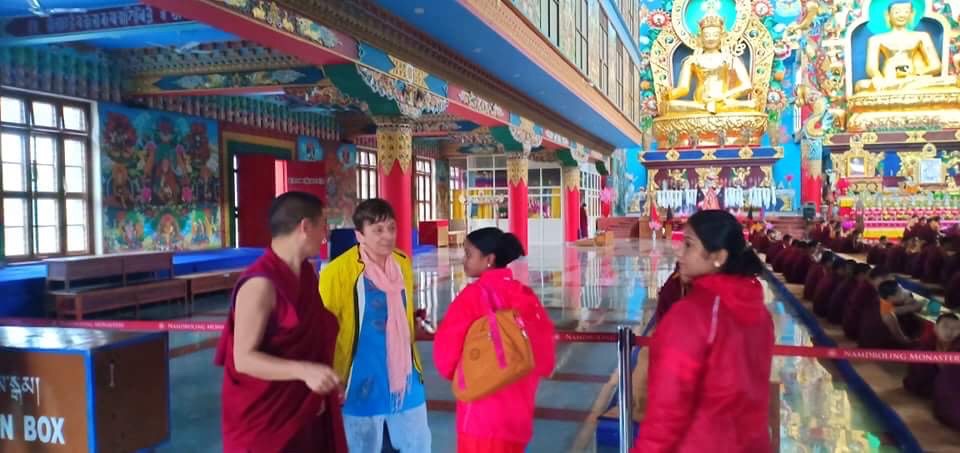
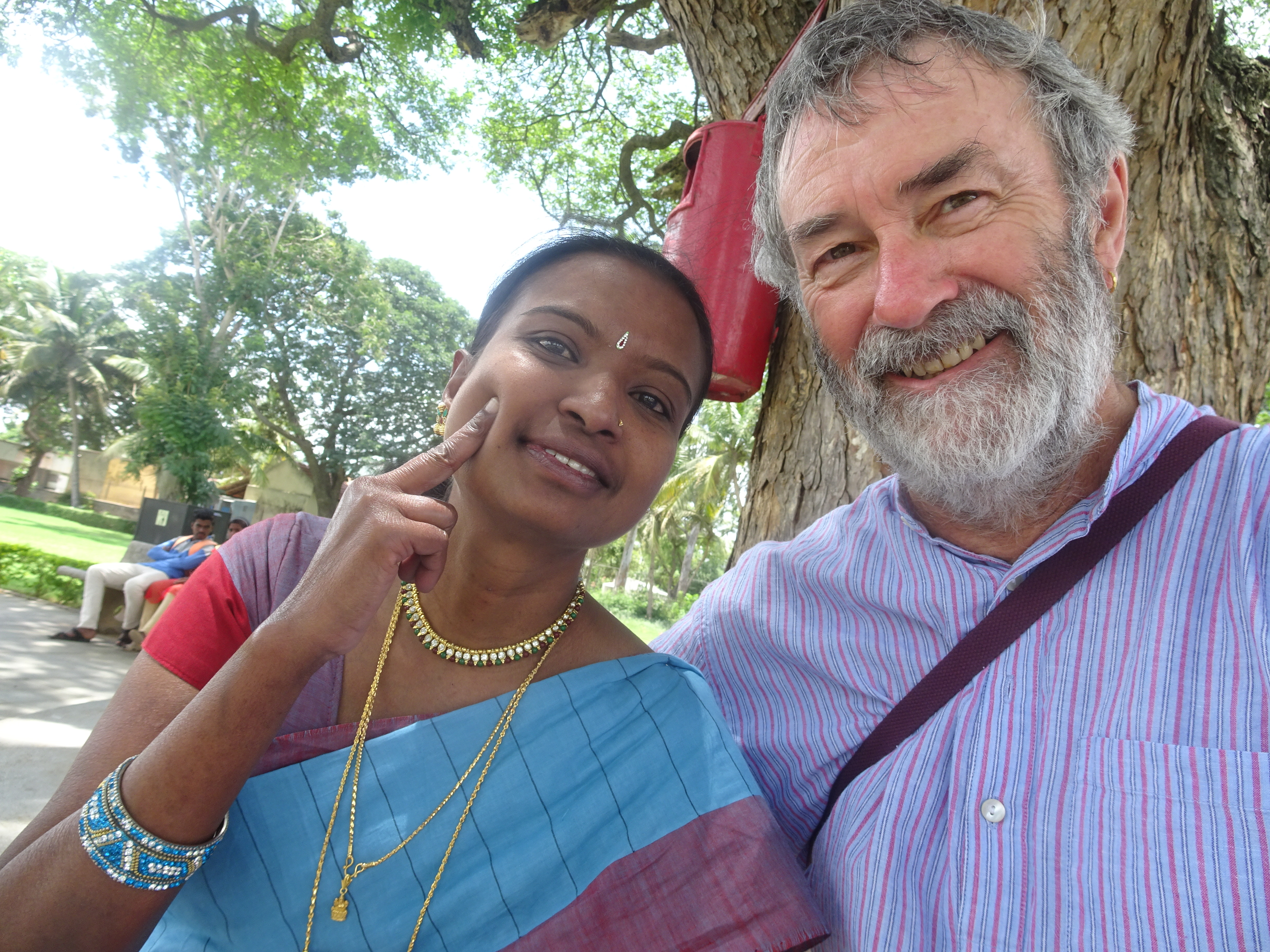
The photos are from our last year with Manjula visiting the local Tibetan settlement and Somnathpur Temple. Ina, Manjula, Willan (our workawayer in 2018) and myself, Stephen
I was their sometime chauffeur
Together, celebrating Manjula’s last birthday in 2018
We will miss Ina, a wonderful caring character, who has become part of our life, here in Mysore. After Manjula died she often referred to her as a Lotus who had survived and thrived through the mud. They both radiated their goodness as sisters and had a wicked sense of humour
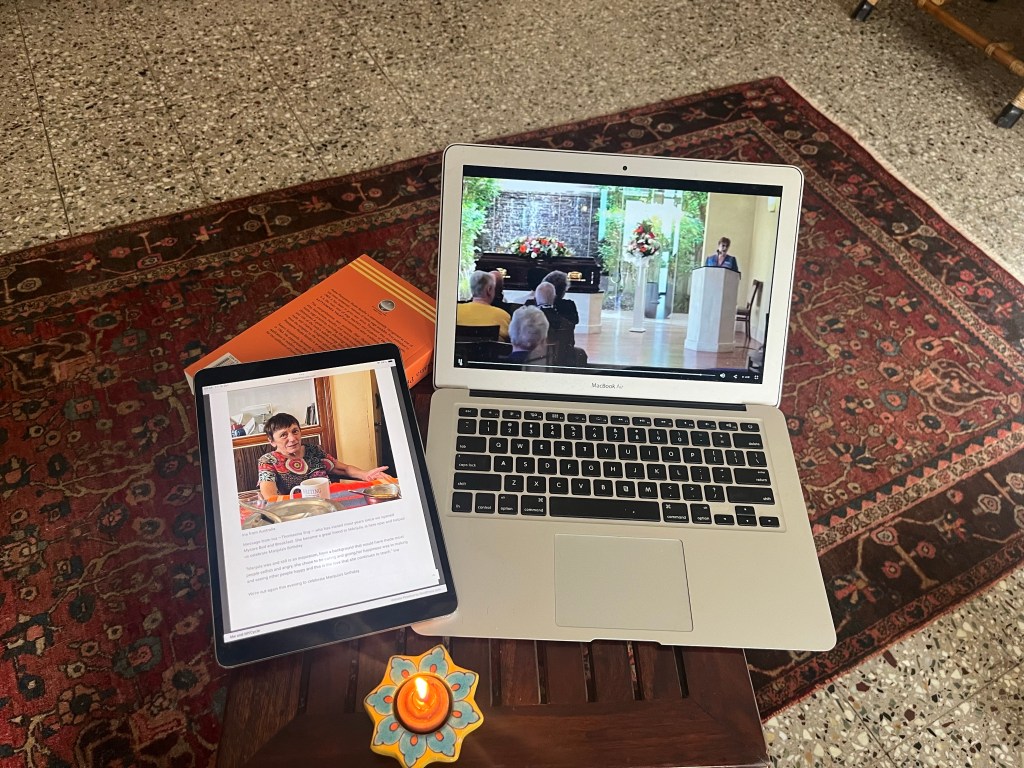
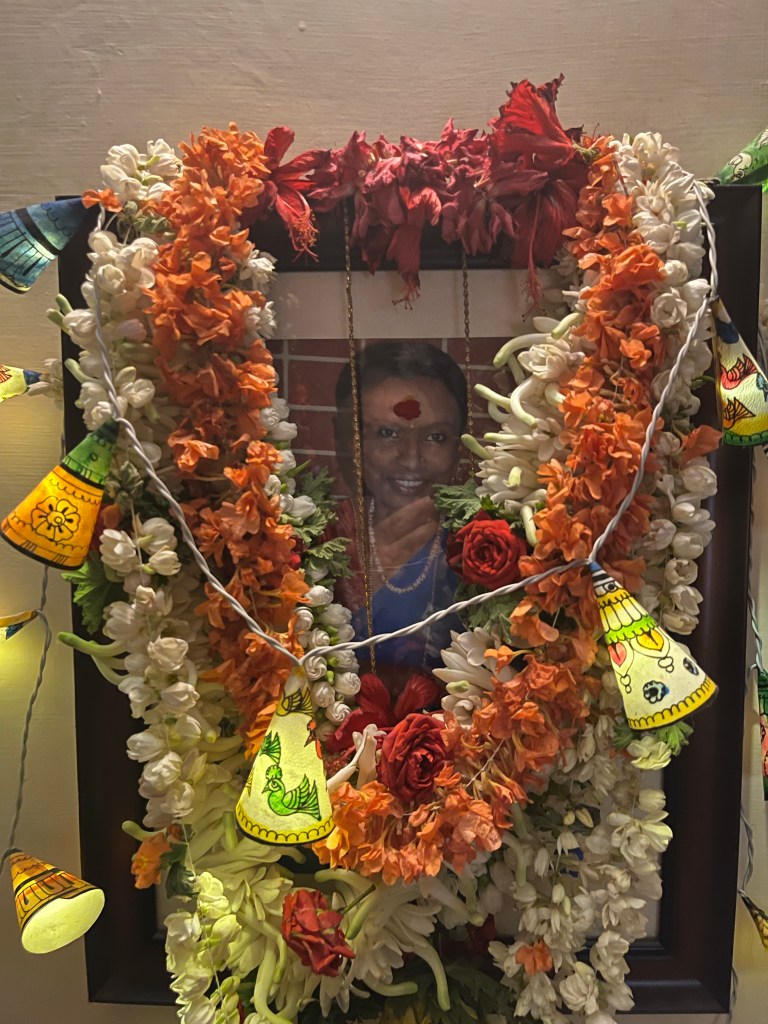
Ina lit a candle for her and what we’ll do each year is a Puja for both Manjula and Ina to help their spirits find their new home.






















 Me and MYCycle