Well it’s pretty obvious it wasn’t a deal breaker. Not only did Manjula start working for me, that was almost eight years ago, she’s now taken over in more ways than one!
So what was the problem?
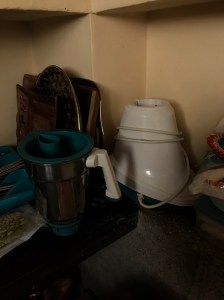
There was no electric mixer!
I can assure you one was bought the very next day. It’s done sterling service ever since.
The panic was actually created by the traditional method of grinding…..
Which just wouldn’t do. Manjula, as I was to find out is a very modern miss.
I arrived at my friend Cariappa’s house to meet the prospective maid.
I have no photos of the meeting. I think the whole thing, for everyone involved was all too intense! We were checking each other out. How weird. Would we get on? How would we know? It’s quite an intimate thing. Inviting someone into your home to cook, clean, and look after things. This was a whole now experience for me. Manjula of course had been here before she had worked as a maid for over ten years for one family, amongst many other things. Me, I was the beginner, the intrepid explorer stepping out into the unknown.
Help!
I’d only supposed to come out to a India for a few months’ pilot. Now I was renting a house, furnishing it, employing a maid. What had happened there… A whole new adventure, in a crazy land and with so many twists and turns…. Whatever next!?
…. if only I’d known!
What would she be like? What did I want and how would I communicate it?
What would she think? (I found out later!) Working for a foreigner would be so different, maybe! It’s worth me remembering I’m from a poor background that’s shifted into the middle class and now living abroad in India. ‘The old poor made good’ which as it turned out, is exactly the path that many in India are taking.
Manjula was quiet, shy, reserved. She’d brought a friend with her for moral support. Good idea! We spoke a few words with Cary and his wife Ganga helping out. I just wanted someone to cook a meal and clean. We then walked round the corner to my house. Things seemed to be going well. They looked around the place, it seemed so big to me. There’s so much to clean but only me, honest! Just the upstairs house with three bedrooms (known locally as a 3BHK) the downstairs house came later. It was sparsely furnished with little on the walls, it’s hard to imagine what it was like ( so, so different now) but then oh no……..we hit a problem….. it was all off ……we’d found the deal breaker..
It’s almost eight years ago that I moved to India and mentioned to my grown-up sons that I was looking for a maid. They were horrified.
We’re from the UK, are quite liberal and left wing. I’m actually from a relatively poor working class background. The idea of having a servant was also way beyond the usual more acceptable (in the UK anyway) middle class practice of a cleaner.
It introduces a class dimension. It’s seen as a bit 19th century, old-fashioned, elitist and servants are employed by people who are not like us! Who see themselves a cut above the rest, or the hoi polloi , a case of upstairs/downstairs. In our world view, its all completely unacceptable.
as you can see its a big house and I need help! Fact is, I only had the first floor eight years ago
I explained as best I could. It was important to provide employment particularly as there was no real welfare safety net in India. I was fitting in with the way things are, and my approach would be different (yep, it would be!) I would be a sensitive and caring employer.
So I asked my friends Ganga and Cariappa if they could recommend someone. The maid network came up with someone pretty quickly.
I was called round to meet someone.
So what’s the bigger picture? once again Tripti Lahiri helps out:
“Britain saw the number of servants drop from 250,000 in 1951 to 32,000 two decades later.”
India followed a similar trajectory until that is, the 1970’s when there began a dramatic increase in the numbers of servants (we’ll come back to terminology later) employed and this is a situation reflected globally.
“According to international labour groups, as of 2010. there were more than 50 million such workers globally, an increase of nearly 20 million from 1995, most of this made up of women. There are now over 40 million female domestic workers globally.”
So OK that’s enough with all the big numbers, what does this mean in practice for the women involved? who are they? where are they from and what lives do they lead?
Quotes taken from ‘Maid in India’ by Tripti Lahiri :
an image from a postcard that we publish
“We eat first, they later, often out of food portioned out for them; we live in the front, they in the back; we sit on chairs and they on the floor; we drink from glasses and ceramic plates and they from ones made of steel set aside for them; we call them by their names, and they address us by titles: sir/ma’am, sahib/memsahib”
Think that’s in the past?
Well, think again.
“In today’s India its not unusual to see, often in largely empty restaurants, a couple seated with their child at a table for four, while the help is despatched to sit not one but two tables away….. or a nanny dandling a child on her lap at a nightclub while her employers and their friends drink cocktails as it creeps towards midnight, her hours of sleep dwindling since she is no doubt expected to be up and ready for another day at sunrise…. or for example children playing in a neighbourhood park, seeing a plump, light-skinned boy on a swing crook his finger at the petite darker woman standing nearby and utter a single word: Push”
Womens’ life experience is an incredible indicator of how a particular society works, from top to bottom.
In India the situation of women and particualrly those who are most socially and economically excluded, in this case, the ones that serve others, shines a spotlight on the social mores, the rules by which we operate, the structures and belief systems that helps maintain the status quo.
It also shows something else.
That is, how these women in often extraordinarily challenging circumstances not only manage but can thrive, can flourish and through that, show their astonishing abilities. In a sense, the influence they subtly exert and how they deal with the changes facing them can also demonstrate to us, on a macro level, how to deal with some of the challenges and opportunities facing contemporary India.





 Me and MYCycle